Decentralized Clinical Trials (DCTs) are no longer a future concept, they are a present-day necessity. As patient-centricity, digital transformation, and remote healthcare solutions continue to evolve, regulatory bodies like the U.S. Food and Drug Administration have stepped forward with clear guidance to ensure that innovation does not compromise safety, compliance, or data integrity.
In this blog, we break down the FDA’s guidance on decentralized clinical trials, its key components, regulatory expectations, and what it means for sponsors, CROs, and patients in 2026.
What Are Decentralized Clinical Trials?
Decentralized Clinical Trials (DCTs) are transforming the way clinical research is conducted by leveraging digital technologies and remote processes, reducing the need for participants to frequently visit traditional trial sites. Instead of relying solely on in-person interactions, DCTs use a combination of telemedicine consultations, wearable devices for continuous remote monitoring, Electronic Clinical Outcome Assessments (eCOA) for real-time patient data collection, and direct-to-patient drug shipments. This patient-centric approach not only improves accessibility and convenience for participants but also enhances data quality, accelerates study timelines, and supports more flexible, efficient clinical trial execution.
Why FDA Guidance on DCTs Important
The U.S. Food and Drug Administration (FDA) introduced formal guidance on decentralized clinical trials (DCTs) in response to the rapid adoption of remote and technology-driven trial methods. This guidance plays a critical role in ensuring that, despite the shift away from traditional site-based models, patient safety remains uncompromised, data integrity and reliability are consistently maintained, and regulatory compliance is upheld across all trial formats. By providing a structured framework, the FDA helps sponsors and CROs confidently implement decentralized approaches while meeting rigorous regulatory standards.
Core Principles Behind FDA Guidance
The FDA’s framework for DCTs is built on three foundational pillars:
1. Patient-Centricity
Patient-centricity in clinical trials focuses on designing studies that prioritize participant comfort, convenience, and overall experience while maintaining the highest standards of safety and data quality. This approach involves reducing the burden on patients by offering flexible visit schedules that fit their daily lives, enabling home-based assessments to minimize the need for frequent site visits, and decreasing travel requirements. By making participation easier and more accessible, patient-centric trial designs not only improve recruitment and retention rates but also enhance the reliability and completeness of collected data.
2. Risk-Based Approach
A risk-based approach is essential when implementing decentralized elements in clinical trials. Sponsors are encouraged to carefully evaluate which components of a study can be effectively decentralized by considering factors such as the complexity of the trial, the characteristics of the patient population, and the specific therapeutic area involved. This ensures that patient safety, data quality, and regulatory compliance are not compromised. Importantly, not all trials are suitable for full decentralization for each study requires a tailored strategy, where decentralization is applied thoughtfully based on its unique requirements.
3. Regulatory Accountability
In decentralized clinical trial models, regulatory accountability remains clearly defined despite the use of digital tools and remote processes. Investigators continue to hold primary responsibility for patient safety, medical oversight, and clinical decision-making throughout the study. Sponsors retain overall accountability for trial conduct, ensuring compliance with regulatory requirements, data integrity, and proper monitoring. While Contract Research Organizations (CROs) play a critical role in supporting trial execution, operations, and coordination, they do not assume the ultimate regulatory responsibility. This structured division of roles ensures that even in decentralized environments, clinical trials maintain high standards of compliance, safety, and accountability.
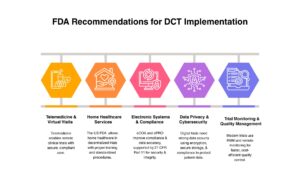
FDA Recommendations for DCT Implementation
1. Telemedicine and Virtual Visits
Telemedicine and virtual visits play a central role in decentralized clinical trials (DCTs), enabling patients to participate in studies from the comfort of their homes. According to FDA guidance, remote consultations are permitted as long as they are conducted by licensed practitioners, patient identity is properly verified, and all medical records are accurately documented and securely maintained. By integrating telehealth into clinical trial workflows, sponsors can significantly improve patient accessibility, reduce travel burdens, and enhance overall participation rates, while still ensuring robust clinical oversight and regulatory compliance.
2. Home Healthcare Services
The US FDA permits the use of local home healthcare providers in decentralized clinical trials for activities such as sample collection, drug administration, and routine patient check-ups. This approach enhances patient convenience and reduces the need for frequent site visits, making clinical trials more accessible and patient-friendly. However, to maintain data integrity and patient safety, sponsors are required to ensure that all home healthcare staff are properly trained and qualified. Additionally, standardized procedures must be implemented consistently across all locations to ensure uniformity in data collection and adherence to regulatory requirements.
3. Electronic Systems and Compliance
Electronic Clinical Outcome Assessment (eCOA) and Electronic Patient-Reported Outcome (ePRO) systems play a critical role in modern clinical trials by enabling real-time patient data reporting, reducing recall bias, and significantly improving patient compliance rates. These digital tools allow participants to record their symptoms, experiences, and outcomes directly, ensuring more accurate and timely data collection. Simultaneously, regulatory compliance remains essential. In accordance with 21 CFR Part 11, electronic systems used in clinical research must adhere to strict standards, including secure login protocols to protect user access, comprehensive audit trails to track data changes, and full data traceability to ensure integrity and transparency. Together, these elements ensure that electronic systems not only enhance efficiency but also maintain the highest standards of regulatory compliance and data reliability.
4. Data Privacy and Cybersecurity
With the growing adoption of digital tools in clinical trials, data privacy and cybersecurity have become critical priorities. The FDA emphasizes the need for robust safeguards, including encryption of patient data, secure cloud storage solutions, and strict compliance with global data privacy regulations. These measures are essential to protect sensitive patient information from breaches and unauthorized access. As clinical trials become more decentralized and technology-driven, sponsors must take a proactive approach to identifying and mitigating cybersecurity risks, ensuring both regulatory compliance and patient trust.
5. Trial Monitoring and Quality Management
Trial monitoring and quality management in modern clinical trials are rapidly evolving, with traditional on-site monitoring approaches being replaced by more efficient and technology-driven methods. Strategies such as Risk-Based Monitoring (RBM), centralized data review, and remote audits are now widely adopted to enhance oversight and streamline operations. These approaches enable real-time visibility into trial data, allowing sponsors and CROs to identify potential issues much earlier than before. As a result, trials benefit from faster issue detection, significantly reduced monitoring costs, and a more proactive approach to maintaining quality. Ultimately, this shift supports continuous quality improvement while ensuring regulatory compliance and data integrity throughout the study lifecycle.
Benefits of FDA-Supported Decentralized Trials
DCTs, when aligned with FDA guidance, offer major advantages:
✔ Improved Patient Recruitment & Retention
✔ Greater Diversity in Clinical Trials
✔ Faster Trial Execution
✔ Real-Time Data Collection
Operational Challenges in Decentralized Clinical Trials
While Decentralized Clinical Trials (DCTs) offer significant advantages, they also present several important challenges and considerations. One of the primary concerns is ensuring technology accessibility for all patients, as not every participant may have access to or familiarity with digital tools required for remote participation. Additionally, data privacy and cybersecurity risks remain a critical issue, given the increased reliance on digital platforms and remote data collection. Proper training for both clinical sites and participants is also essential to ensure smooth adoption and minimize errors. Furthermore, navigating regulatory requirements across different regions can be complex, as guidelines for DCTs continue to evolve globally. Pro Tip: Partnering with experienced CROs like ProRelix Research can help organizations effectively address these challenges and ensure successful trial execution.
Future of FDA Guidance on Decentralized Trials
The future of FDA guidance on decentralized clinical trials (DCTs) is set to evolve alongside rapid technological advancements and shifting industry needs. As AI-driven trials become more prevalent, wearable device integrations expand, and hybrid trial models continue to dominate, the FDA is expected to refine further and adapt its regulatory frameworks to ensure both innovation and patient safety. These updates will likely focus on enhancing data reliability, improving remote monitoring standards, and strengthening patient privacy protections. Moving into 2026 and beyond, decentralized clinical trials will not replace traditional site-based studies; instead, they will work in tandem to create a more flexible, efficient, and patient-centric clinical research ecosystem that improves accessibility, engagement, and overall trial outcomes.
Conclusion
The FDA’s guidance on decentralized clinical trials provides a strong regulatory framework that balances innovation with patient safety and data integrity. For sponsors and CROs, understanding and implementing these guidelines is critical to running successful, compliant, and efficient trials.
DCTs are transforming clinical research and with the FDA’s support, they are here to stay.
FAQs
1. What is the FDA’s stance on decentralized clinical trials?
The FDA supports DCTs as long as they maintain patient safety, data integrity, and regulatory compliance.
2. Are decentralized trials fully remote?
Not always. Many trials follow a hybrid model combining remote and on-site activities.
3. What technologies are allowed in DCTs?
The FDA allows digital health technologies like ePRO, wearables, and telemedicine, provided they are validated and compliant.
4. How does FDA ensure data integrity in DCTs?
Through strict requirements such as secure systems, audit trails, and compliance with 21 CFR Part 11.
5. Can investigational drugs be shipped directly to patients?
Yes, but only with proper controls, documentation, and compliance with regulatory guidelines.