
Patient compliance has always been one of the most critical—and challenging—aspects of clinical trials. Missed visits, incomplete diaries, and inconsistent reporting can compromise data integrity, delay timelines, and increase study costs. In 2026, Electronic Patient-Reported Outcomes (ePRO) systems are transforming how clinical trials engage participants and ensure consistent data collection.
By combining technology, real-time communication, and patient-centric design, ePRO is redefining compliance in modern clinical research.
What is ePRO in Clinical Trials?
Electronic Patient-Reported Outcomes, commonly known as ePRO, refer to digital platforms that allow patients to report their health status, symptoms, and treatment responses using devices such as smartphones, tablets, or web-based applications. Unlike traditional paper diaries, ePRO systems enable real-time data entry, reduce the chances of recall bias, and ensure higher accuracy. These platforms are often integrated with broader digital ecosystems used in clinical trials, supporting seamless data flow between patients, investigators, and sponsors.
Why Patient Compliance is a Critical Concern
Patient compliance is essential for maintaining the integrity and reliability of clinical trial data. However, several factors contribute to poor adherence, including complex study protocols, frequent site visits, and lack of continuous engagement. Patients may lose motivation over time or struggle to follow strict schedules, especially in long-duration studies. Regulatory authorities such as the U.S. Food and Drug Administration emphasize the importance of consistent and accurate patient-reported data, as inconsistencies can affect both the scientific validity of a study and its chances of approval.
How ePRO Improves Patient Compliance?
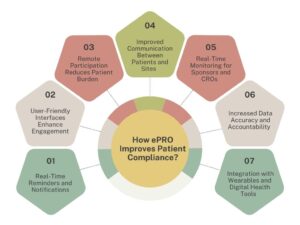
1. Real-Time Reminders and Notifications
Real-time reminders and notifications play a crucial role in improving patient compliance in clinical trials. ePRO platforms are designed to automatically send timely alerts to participants for essential activities such as medication intake, daily diary entries, and scheduled assessments. These automated notifications act as consistent prompts, helping patients stay aligned with study protocols without relying on memory alone. As a result, the likelihood of missed entries is significantly reduced, ensuring more accurate and timely data collection. This continuous engagement not only simplifies participation for patients but also leads to higher adherence rates, ultimately enhancing the overall quality and reliability of clinical trial outcomes.
2. User-Friendly Interfaces Enhance Engagement
Modern ePRO systems are built with user-friendly and intuitive interfaces that make participation seamless for patients across all age groups. These platforms typically include features such as simple and easy-to-understand questionnaires, multilingual support to accommodate diverse patient populations, and interactive dashboards that enhance the overall user experience. By minimizing complexity and making the process more accessible, ePRO solutions significantly reduce the burden on patients. As a result, better usability directly contributes to higher engagement levels, improved compliance, and more consistent participation throughout the clinical trial.
3. Remote Participation Reduces Patient Burden
Remote participation plays a crucial role in reducing patient burden in modern clinical trials, and ePRO solutions are at the center of this transformation. By enabling patients to submit their data from the comfort of their homes, ePRO eliminates the need for frequent site visits, saving time, effort, and travel costs. This approach is particularly valuable in decentralized clinical trials (DCTs), where remote engagement is essential, as well as for patients living in geographically distant or underserved areas. It also significantly improves the experience for participants enrolled in long-term studies, where repeated visits can often lead to fatigue and dropouts. As a result, minimizing these logistical challenges not only enhances patient convenience but also increases their willingness to remain compliant and actively engaged throughout the study duration.
4. Improved Communication Between Patients and Sites
Improved communication between patients and clinical trial sites plays a crucial role in ensuring study success, and ePRO platforms significantly enhance this interaction. With built-in communication tools, patients can easily connect with study coordinators through instant messaging, receive timely alerts for missed diary entries, and get quick responses to any queries or concerns they may have during the trial. This seamless, real-time communication reduces confusion, minimizes delays, and helps patients feel more supported throughout their participation. As a result, stronger relationships between patients and research sites are established, ultimately leading to better adherence, higher engagement, and improved overall data quality in clinical trials.
5. Real-Time Monitoring for Sponsors and CROs
Real-time monitoring has become a critical capability for sponsors and CROs in modern clinical trials, enabling study teams to track patient activity as it happens and respond quickly when compliance begins to decline. By leveraging digital tools, teams can easily detect missed entries, identify irregular reporting patterns, and trigger timely follow-ups to re-engage participants. This proactive approach not only helps in maintaining consistent data collection but also ensures that potential issues are addressed before they escalate. As a result, real-time monitoring plays a key role in preventing data gaps, enhancing patient retention, and ultimately improving the overall quality and reliability of clinical trial outcomes.
6. Increased Data Accuracy and Accountability
Increased data accuracy and accountability are among the most significant advantages of digital tools in clinical trials. With features like digital timestamps and automated validations, patient entries are recorded in real time, ensuring that data is submitted on schedule. These systems also help maintain completeness and consistency by prompting users to fill in missing information and flagging any discrepancies instantly. Additionally, the risk of backdated or falsified entries is greatly reduced, as every action is securely tracked within the system. As a result, patients become more accountable for their inputs, ultimately leading to highly reliable, transparent, and audit-ready data that meets regulatory expectations.
7. Integration with Wearables and Digital Health Tools
Integration with wearable devices and digital health tools has become a defining feature of modern ePRO platforms. These systems can seamlessly connect with wearable devices, sensors, and remote monitoring technologies to capture real-time health data without requiring active input from patients. By combining passively collected data with patient-reported outcomes, clinical trials gain a more comprehensive and accurate view of patient health and behavior. This approach significantly reduces the burden of manual data entry, minimizes reporting errors, and enhances overall patient compliance. Simultaneously, it enriches the dataset with continuous, objective insights, ultimately improving the quality and reliability of clinical trial outcomes.
Real-World Impact of ePRO Adoption
The adoption of ePRO systems has led to noticeable improvements across the clinical trial lifecycle. Studies that leverage ePRO often experience higher patient retention, fewer protocol deviations, and improved data completeness. Operational efficiency also improves, as automated processes reduce administrative workload and streamline data management. For organizations looking to stay competitive in the evolving clinical research landscape, integrating ePRO into their digital strategy is becoming essential. Platforms like ProCTTH can support this transformation by offering integrated solutions that enhance both patient engagement and operational efficiency.
Best Practices for Maximizing Compliance with ePRO
To fully realize the benefits of ePRO, it is important to focus on patient-centric implementation. Designing simple and engaging questionnaires ensures that patients do not feel burdened while reporting their data. Proper onboarding and training help participants understand how to use the platform effectively from the beginning. Continuous support and clear communication further strengthen patient confidence and participation. When combined with strong data security measures, these practices create a reliable and user-friendly environment that encourages long-term compliance.
The Future of ePRO in Clinical Trials
As clinical trials continue to evolve, ePRO systems are expected to become even more advanced. The integration of artificial intelligence will enable predictive insights into patient behavior, allowing study teams to identify compliance risks before they occur. Voice-enabled reporting and smarter interfaces will further simplify patient interaction, while deeper integration with decentralized trial technologies will create a seamless and connected ecosystem. These advancements will reinforce the role of ePRO as a cornerstone of modern clinical research.
Conclusion
ePRO has fundamentally changed how patient compliance is managed in clinical trials. By combining real-time engagement, user-friendly design, remote accessibility, and data accuracy, it addresses many of the challenges associated with traditional methods. As the industry continues to move toward patient-centric and decentralized clinical trial models, adopting ePRO is no longer optional but essential for ensuring successful trial outcomes.
FAQs
1. What is ePRO in clinical trials?
ePRO refers to digital systems that allow patients to report their health data directly through electronic devices, improving accuracy and compliance.
2. How does ePRO improve patient compliance?
It enhances compliance through reminders, easy-to-use interfaces, remote access, and real-time communication with study teams.
3. Is ePRO suitable for decentralized clinical trials?
Yes, ePRO is a key component of decentralized trials as it enables remote data collection and reduces the need for site visits.
4. Does ePRO improve data quality?
Yes, ePRO ensures better data quality through real-time entry, automated validation, and elimination of manual errors.
5. Can ePRO integrate with other clinical technologies?
ePRO can integrate with wearables, sensors, and other digital health tools to provide a more comprehensive and accurate dataset.