
Table of Contents
ToggleClinical research is evolving rapidly. Traditional clinical trials that require patients to visit hospitals or research sites frequently are slowly being replaced by more flexible and patient-centric approaches. One of the biggest transformations in the industry is the rise of Decentralized Clinical Trials(DCTs).
In 2026, decentralized trials are no longer just an innovation. They are becoming the new standard for modern clinical research, enabling sponsors, CROs, and research organizations to conduct studies faster, more efficiently, and with better patient engagement.
This complete guide explains what decentralized clinical trials are, how they work, their benefits, challenges, and why they are shaping the future of drug development.
What Are Decentralized Clinical Trials?
Decentralized Clinical Trials (DCTs) are clinical studies that use digital technologies and remote data collection methods to allow patients to participate in research without frequent visits to physical trial sites.
Instead of requiring participants to travel to hospitals or research centers, decentralized trials use technologies such as:
-
Mobile health applications
-
Telemedicine consultations
-
Electronic consent systems
-
Remote patient monitoring devices
-
Electronic Clinical Outcome Assessment (eCOA) tools
These technologies enable researchers to collect trial datadirectly from patients in their homes or local environments.
For example, a patient participating in a decentralized trial may:
-
Submit symptom data through a mobile app
-
Complete electronic questionnaires remotely
-
Attend virtual doctor visits via telemedicine
-
Use wearable devices to track health metrics
These methods reduce the burden on patients while maintaining high-quality clinical data.
For organizations exploring modern research solutions, platforms like ProCTTH Mobile App support decentralized and hybrid trial management by enabling remote patient engagement and secure data collection.
Traditional vs Decentralized Clinical Trials
Understanding the difference between traditional and decentralized trials highlights why DCTs are gaining momentum.
Traditional Clinical Trials
In traditional trials:
-
Patients must visit a clinical site frequently
-
Data is collected during site visits
-
Monitoring is performed on-site
-
Recruitment is limited to local geographic areas
This approach often leads to patient dropouts, slow recruitment, and higher operational costs.
Decentralized Clinical Trials
Decentralized trials use digital tools to reduce physical visits and improve accessibility.
Key characteristics include:
-
Remote patient participation
-
Telemedicine consultations
-
Mobile data collection
-
Wearable health monitoring devices
-
Electronic patient reported outcomes (ePRO)
These innovations improve trial accessibility and enable researchers to reach participants globally.
According to the FDA guidance on decentralized clinical trials, remote data collection technologies can significantly enhance patient participation and study efficiency when implemented with proper regulatory oversight.
Why Decentralized Clinical Trials Are Growing in 2026
The rapid growth of decentralized trials is driven by several factors.
Patient-Centric Research
Patients today expect healthcare experiences that are convenient and flexible. Decentralized trials allow participants to contribute to medical research without disrupting their daily lives.
Faster Patient Recruitment
Traditional trials often struggle with recruitment because participants must travel to trial sites. Decentralized trials remove geographic barriers, enabling global patient enrollment.
Improved Data Collection
Digital tools such as wearable devices and mobile health applications allow researchers to collect continuous real-world data, providing deeper insights into patient outcomes.
Reduced Operational Costs
By reducing site visits and physical infrastructure requirements, decentralized trials can significantly lower the overall cost of clinical research.
Organizations offering advanced clinical trial technology platforms can streamline these processes and improve study efficiency.
Technologies That Enable Decentralized Clinical Trials
Several technologies make decentralized trials possible.
Telemedicine Platforms
Telemedicine allows investigators to conduct virtual consultations with patients, reducing the need for in-person visits.
Electronic Consent (eConsent)
Electronic informed consent systems allow participants to review and sign consent documents digitally, improving transparency and regulatory compliance.
Electronic Clinical Outcome Assessments (eCOA)
eCOA systems collect patient responses electronically, improving accuracy and reducing data entry errors.
Electronic Patient Reported Outcomes (ePRO)
ePRO tools allow patients to report symptoms, side effects, and treatment responses directly through digital platforms.
Wearable Devices and Remote Monitoring
Wearables track vital signs such as heart rate, physical activity, and sleep patterns, enabling continuous monitoring throughout the study.
These technologies work together to create a fully connected digital clinical trial ecosystem.
Benefits of Decentralized Clinical Trials
Decentralized trials provide several advantages for both sponsors and patients.
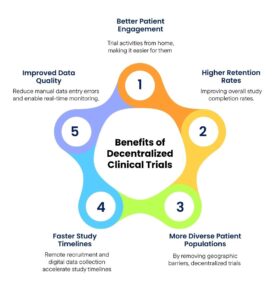
Better Patient Engagement
Participants can complete trial activities from home, making it easier for them to stay involved in the study.
Higher Retention Rates
Convenience leads to fewer dropouts, improving overall study completion rates.
More Diverse Patient Populations
By removing geographic barriers, decentralized trials enable researchers to include more diverse patient populations.
Faster Study Timelines
Remote recruitment and digital data collection accelerate study timelines, helping sponsors bring treatments to market faster.
Improved Data Quality
Digital tools reduce manual data entry errors and enable real-time monitoring.
Many modern CROs are adopting decentralized technologies to improve the efficiency of clinical trial management and remote patient monitoring.
Challenges of Decentralized Clinical Trials
Despite their advantages, decentralized trials also present challenges.
Regulatory Compliance
Sponsors must ensure that remote data collection complies with regulatory guidelines from agencies such as the FDA and EMA.
Data Security
Protecting patient data and ensuring secure data transmission is critical when using digital platforms.
Technology Adoption
Not all patients are comfortable using mobile health technologies, which can affect participation.
Operational Complexity
Managing remote logistics, such as delivering study medications and coordinating home healthcare visits, requires strong operational planning.
However, with proper infrastructure and technology platforms, these challenges can be effectively addressed.
Hybrid Clinical Trials: The Balanced Approach
Many studies today use a hybrid clinical trial model, combining both traditional site visits and decentralized technologies.
For example:
-
Initial screening may occur at a clinical site
-
Follow-up visits may be conducted remotely
-
Data collection may occur through mobile apps and wearable devices
Hybrid trials offer the best of both worlds by maintaining regulatory oversight while improving patient convenience.
The Future of Decentralized Clinical Trials
Decentralized trials are expected to continue growing in the coming years as clinical research becomes more digital and patient-focused.
Future innovations may include:
-
Artificial intelligence for patient recruitment
-
Advanced wearable health monitoring devices
-
Real-time data analytics
-
Global virtual clinical trial platforms
These technologies will enable sponsors and CROs to conduct faster, more efficient, and more inclusive clinical trials.
Organizations that adopt decentralized trial technologies early will be better positioned to lead the next generation of drug development.
Conclusion
Decentralized Clinical Trials are transforming the clinical research landscape by making studies more accessible, efficient, and patient-friendly.
By leveraging technologies such as telemedicine, electronic consent, remote monitoring, and mobile health applications, decentralized trials reduce the burden on participants while improving the quality of clinical data.
As the industry continues to evolve, decentralized and hybrid trials will play a critical role in accelerating drug development and expanding access to clinical research worldwide.
For sponsors and clinical research organizations looking to modernize their trial operations, adopting decentralized trial technologies is no longer optional—it is becoming a key driver of innovation in clinical research.
FAQs About Decentralized Clinical Trials
1. What is the main purpose of decentralized clinical trials?
The main purpose of decentralized clinical trials is to make clinical research more accessible by allowing patients to participate remotely using digital technologies and remote monitoring tools.
2. Are decentralized clinical trials approved by regulatory authorities?
Yes. Regulatory agencies such as the FDA support decentralized trials when they comply with proper data integrity, patient safety, and regulatory guidelines.
3. What technologies are used in decentralized clinical trials?
Common technologies include telemedicine platforms, electronic consent systems, wearable health devices, mobile health apps, ePRO tools, and eCOA systems.
4. What is the difference between decentralized and hybrid clinical trials?
Decentralized trials are fully remote, while hybrid trials combine traditional site visits with remote digital technologies.
5. Why are decentralized clinical trials important for the future of drug development?
Decentralized trials improve patient recruitment, increase study efficiency, reduce costs, and enable more diverse patient participation, making drug development faster and more inclusive.