In today’s rapidly growing clinical research landscape, patient-centricity is no longer optional it is essential. As Decentralized Clinical Trials (DCTs) continue to reshape how clinical studies are designed and conducted, Patient-Reported Outcomes (PROs) have emerged as a powerful driver of meaningful engagement, real-world data capture, and regulatory success. By enabling patients to directly report their symptoms, experiences, and quality-of-life impacts through digital platforms, PROs bridge the gap between remote trial execution and authentic patient insight. When strategically integrated into DCT frameworks, PROs not only enhance retention and data quality but also strengthen pharmacovigilance, compliance, and overall trial performance.
What Are Patient-Reported Outcomes (PROs)?
Patient-Reported Outcomes (PROs) constitute a cornerstone of modern evidence-based medicine, encapsulating direct subjective appraisals from patients regarding their health status, treatment experiences, and life impacts, unmediated by clinician interpretation. Unlike clinician-reported or objective biomarkers, PROs prioritize the patient’s lived phenomenology, capturing multidimensional constructs such as symptom severity, functional status, health-related quality of life (HRQoL), and treatment satisfaction. This patient-centric paradigm aligns seamlessly with regulatory imperatives from bodies like the FDA and EMA, which mandate PRO integration in labeling claims for chronic conditions, oncology, and rare diseases.
The Rise of Decentralized Clinical Trials (DCTs)
Decentralized Clinical Trials (DCTs) are transforming clinical research by leveraging digital tools to move activities outside traditional sites. DCTs enable trial procedures like visits, monitoring, and data collection from participants’ homes or local facilities, using telemedicine, wearables, and apps. This shift reduces reliance on centralized locations, incorporating elements like remote consent, virtual check-ins, and direct-to-patient drug shipping. Unlike traditional trials limited by geography, DCTs prioritize patient-centric design for broader access.
Major Benefits:
| Benefit |
Traditional Trials |
Decentralized Trials |
|
Patient Retention |
20-30% dropout from travel burden | Up to 50% higher via remote options |
|
Data Capture |
Manual entry risks errors | Real-time digital accuracy |
|
Trial Speed |
Site-dependent delays | Faster enrollment/recruitment |
| Costs | High infrastructure | 20-30% reduction |
Technologies Powering DCTs
Core tools include AI for recruitment, blockchain for data security, and sensors for monitoring. Platforms integrate eConsent, virtual visits, and mobile nursing. Future advances like VR training and adaptive protocols promise even greater scalability.
Challenges Ahead
Data privacy, regulatory harmonization, and tech equity remain hurdles. Yet, unified digital platforms are emerging to standardize decentralized clinical trials. For pharmacovigilance pros, DCTs enhance SUSAR reporting via real-time surveillance.
Why PROs Are Key to Targeted DCT Engagement
Patient-Reported Outcomes (PROs) are essential in Decentralized Clinical Trials (DCTs) because they capture real-time patient perspectives on symptoms, quality of life, and treatment experiences, directly enhancing targeted engagement strategies. PROs involve patients directly reporting data via digital tools like apps or wearables, bypassing traditional site visits common in DCTs. This approach aligns with DCT goals of remote participation, making data collection more accessible and patient-centric.
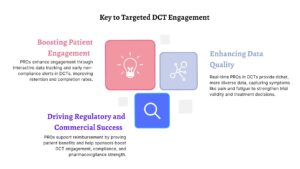
Boosting Patient Engagement
PROs foster active involvement by giving patients ownership of their data, often through gamified apps that track progress and provide feedback, which reduces dropouts and improves retention. In targeted DCTs, PROs enable personalized interventions, such as early alerts for non-compliance, ensuring higher completion rates.
Enhancing Data Quality
Real-time PRO collection in DCTs yields richer, more diverse datasets from hard-to-reach populations, improving trial validity and regulatory value. They highlight subjective impacts like pain or fatigue that clinicians might miss, supporting better treatment decisions.
Driving Regulatory and Commercial Success
PROs strengthen evidence for health technology assessments, influencing reimbursement in oncology and beyond by proving patient-centered benefits. For sponsors, they differentiate DCTs through superior engagement metrics, vital for competitive pharmacovigilance and trial compliance.
PRO Tools and Technologies for DCT Success
Patient-Reported Outcomes (PROs) tools, particularly electronic PRO (ePRO) and eCOA platforms, are essential for Decentralized Clinical Trials (DCTs), enabling remote data capture that boosts patient engagement and trial efficiency. These technologies integrate seamlessly with DCT workflows, supporting pharmacovigilance through real-time adverse event monitoring and compliance.
Key PRO Technologies
ePRO and eCOA systems allow patients to report symptoms and quality-of-life data via apps on personal devices, reducing site visits and improving data quality in DCTs. Wearables and IoT integration provide continuous monitoring, while AI-driven analytics detect signals early for better safety oversight.
-
Real-time data capture via mobile apps enhances adherence (up to 90% in some studies).
-
BYOD (Bring Your Own Device) models cut costs and increase accessibility.
-
Audit trails and edit checks ensure regulatory compliance like 21 CFR Part 11.
Leading Platforms
Top platforms unify ePRO with DCT elements like eConsent and telehealth for end-to-end success.
| Platform | Key Features for DCT/PRO Success | Proven Benefits |
| ProCTTH | eConsent, video/chat, patient diary, behavior monitoring, EDC integration | Reduces dropouts; real-time remote data; low license fee, more cost savings for sponsors/CROs |
| Medable | eCOA/ePRO library (400+), BYOD, AI insights | 80% revenue growth; 90% adherence |
| Medidata | Sensor Cloud, patient app, EDC integration | Unified hybrid/DCT data; real-time performance |
| Remote monitoring, engagement tools | Scalable for diverse populations |
Strategies to Boost Patient Engagement with PROs
Strategies to Boost Patient Engagement with PROs involve leveraging reminders, education, and user-friendly tools to improve completion rates and data quality in clinical research. These approaches are particularly relevant for pharmacovigilance and trial compliance, aligning with GCP standards for accurate patient-reported outcomes (PROs).
Key Strategies
-
Timely Multi-Channel Reminders: Use automated email and SMS reminders to boost response rates by up to 30%, ensuring patients stay on track without overwhelming them.
-
Intuitive Digital Interfaces: Design mobile-friendly ePRO platforms with clear instructions, increasing completion by 25% through accessible, user-centric surveys.
-
Physician Endorsements: Enable direct physician invitations and personalized messaging, making patients 3x more likely to participate.
Implementation Tips
-
Patient Education: Explain PRO importance and post-care instructions during visits to build buy-in and adherence.
-
Personalized Communication: Tailor messages using patient data for reminders, health tips, and telehealth integration to foster trust.
-
Automated Follow-Ups: Deploy post-visit surveys with triggers for low responses, like follow-up calls, to enhance outcomes.
Technology Integration
-
Health Apps and Portals: Offer apps for symptom tracking and EHR-integrated portals for progress viewing, promoting ongoing engagement.
-
Wearables and Secure Messaging: Encourage wearables for real-time feedback and secure chats for quick provider access.
These strategies can significantly improve PRO data reliability in trials, supporting better pharmacovigilance monitoring.
Overcoming Challenges in PRO-Driven DCTs
PRO-driven Decentralized Clinical Trials (DCTs) integrate patient-reported outcomes (PROs) to capture real-world patient experiences remotely, enhancing trial efficiency and patient-centricity. However, implementation faces hurdles like data quality, engagement, and tech integration, which can be addressed through targeted strategies.
Key Challenges
-
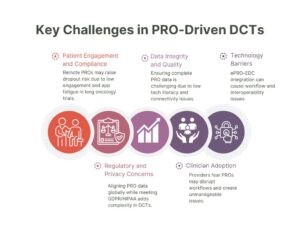
Patient Engagement and Compliance: Remote PRO collection risks dropout due to lack of in-person interaction and app fatigue, especially in long trials like oncology studies.
-
Data Integrity and Quality: Ensuring accurate, complete PRO data without site oversight is tough amid varying patient tech literacy and connectivity issues.
-
Technology Barriers: Integrating ePRO platforms with EDC systems often leads to workflow disruptions, usability issues, and interoperability gaps.
-
Regulatory and Privacy Concerns: Harmonizing PRO data across regions while meeting GDPR/HIPAA standards adds complexity in DCTs.
-
Clinician Adoption: Providers worry PROs will overload workflows or reveal unmanageable issues, hindering routine use.
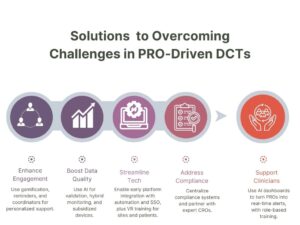
Solutions
-
Enhance Engagement: Use gamified apps, reminders, and dedicated coordinators for personalized support; provide plain-language education and feedback loops.
-
Boost Data Quality: Deploy AI for real-time validation, adaptive reminders, and hybrid monitoring; standardize devices with subsidized access.
-
Streamline Tech: Integrate platforms early via automation and single-sign-on; offer VR training for sites and patients.
-
Address Compliance: Build centralized regulatory databases and automated checks; partner with experienced CROs for navigation.
-
Support Clinicians: Automate workflows with AI dashboards linking PROs to actionable alerts; provide role-specific training.
Implementation Tips
Incorporate DCT-PRO design from protocol synopsis stage for seamless eConsent-to-enrollment flow. Pilot flexible ePRO solutions in high-burden trials, tracking metrics like completion rates (>90% target). For pharmacovigilance pros, align PROs with SUSAR reporting via integrated eSource for audit-ready compliance.
Actionable Steps to Implement PROs in Your DCT
Implementing Patient-Reported Outcomes (PROs) in Decentralized Clinical Trials (DCTs) enhances patient-centric data collection remotely, improving engagement and real-world evidence. This guide outlines actionable steps tailored for clinical research professionals, drawing from established best practices in pharmacovigilance and trial compliance.
Define Objectives and Scope
Start by aligning PRO implementation with trial goals, such as monitoring treatment efficacy or quality of life in DCT settings. Identify key PRO measures (e.g., validated questionnaires like PROMIS or EQ-5D) relevant to your endpoints and ensure they fit remote capture via apps or portals. Engage stakeholders—sponsors, sites, patients—to secure buy-in and define success metrics like completion rates above 80%.
Select Tools and Platforms
Choose ePRO platforms compatible with DCT, supporting mobile/web access, multilingual options, and integration with eISF/eTMF systems for compliance. Prioritize user-friendly interfaces with reminders, offline mode, and data encryption to meet GCP standards. Pilot test with a small cohort to validate usability in diverse populations, including those in regions like India.
Develop Protocols and Training
Incorporate PRO schedules into the trial protocol, specifying frequency, reminders, and handling of missing data per ICH E6(R3). Train site staff, CRCs, and patients via webinars on consent, data entry, and SUSAR linkages. Create patient onboarding materials, like video guides, to boost adherence in virtual settings.
Integrate and Monitor Data
Link PRO data streams to central dashboards for real-time visibility, alerting on low compliance or safety signals. Automate reconciliation with EDC systems to flag deviations early. Use analytics to track metrics like response times and dropout patterns, adjusting strategies iteratively.
Ensure Compliance and Evaluation
Conduct risk assessments for data privacy (GDPR/CTSI compliance) and validate PRO equivalence to site-based methods. Post-implementation, audit processes and survey participants for feedback. Scale successful pilots across the trial, measuring impact on enrollment retention and outcomes.
Final Thoughts: Making PRO-Driven DCTs the New Standard
Patient-Reported Outcomes (PROs) are no longer optional add-ons in modern clinical research—they are strategic assets that define trial success in an increasingly decentralized world. As Decentralized Clinical Trials (DCTs) continue to reshape how studies are designed and executed, PROs provide the essential human dimension that technology alone cannot capture.
By embedding PROs into DCT frameworks:
-
Patients become active contributors, not passive subjects.
-
Data becomes richer and more real-world relevant, strengthening regulatory and reimbursement value.
-
Sponsors gain measurable advantages in retention, engagement, and safety monitoring.
-
Pharmacovigilance systems become proactive, powered by real-time symptom reporting and early signal detection.
The true power of PRO-driven DCTs lies in integration aligning ePRO platforms, AI analytics, wearable data, and regulatory workflows into a seamless ecosystem. When implemented thoughtfully from the protocol design stage, PROs enhance compliance, reduce dropouts, and support audit-ready transparency across global trials.
However, success requires more than technology. It demands:
-
Patient-centered design
-
Clear communication and education
-
Regulatory foresight
-
Strong CRO and sponsor collaboration
-
Continuous monitoring and iterative optimization
For clinical research professionals, especially those in pharmacovigilance, regulatory affairs, and trial operations, PRO-enabled DCTs represent a shift from reactive data collection to predictive, patient-informed decision-making.
In the evolving landscape of hybrid and fully decentralized trials, the question is no longer whether to implement PROs, but how strategically and efficiently they can be embedded to drive measurable clinical, regulatory, and commercial impact.
When patients’ voices are systematically captured, validated, and acted upon, decentralized trials become not just operationally efficient but truly patient-centric.